
Intervertebral Disc Disease (IVDD)
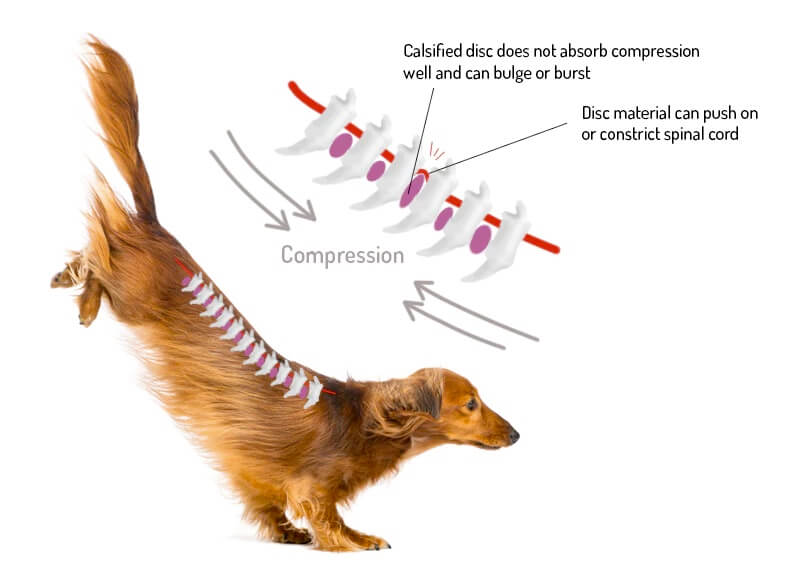
IVDD is a very common disease, most frequently affecting small breed dogs with short legs and long backs.
It also occurs in large breeds such as German Shepherds, where disc degeneration develops with age.
Sudden paralysis is an emergency
If your dog suddenly cannot use their back legs, or loses the ability to feel their feet, this needs immediate attention. The sooner surgery is performed, the better the outcome — ideally within the first 24 hours of paralysis starting.
If we're closed, go directly to the nearest 24-hour emergency or neurology hospital. This is not something to watch overnight.
What's actually happening
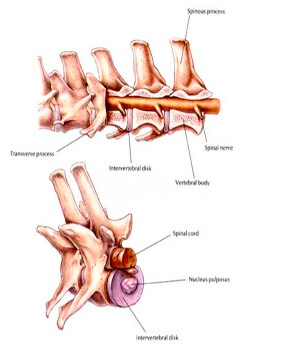
A spinal disc has two parts, and the structure is a bit like a jelly donut. The outer covering — the fibrous ring — is a tough shell of fibers that contains and protects the softer center, the pulpy nucleus, which has roughly the consistency of thick toothpaste.
The disc is thinnest near the spinal cord, so when the outer ring tears, the material that escapes usually pushes upward — directly toward the cord.
Because the spinal cord sits inside a bony canal, it has nowhere to move. It can't shift away from the pressure, so it becomes pinched.
Signs to watch for
Signs can be vague, particularly early on. The most common are:
Pain
Limb weakness, or trouble walking on one or more legs
Overall decreased activity — sleeping more than usual
Lack of appetite
Inability to get comfortable, or snapping when touched
Reluctance to jump or climb stairs
How it's diagnosed
X-rays
Usually the first step — both to rule out more serious conditions and to assess disc calcification and narrowing of the spaces between vertebrae.
Advanced imaging
MRI or CT may be needed to confirm IVDD. This requires referral to a veterinary neurologist.
The Five Stages
Treatment depends on which stage your dog is at. Importantly, these stages can overlap, and a dog can move from one to the next over hours to days — which is why a dog who seems only mildly sore in the morning can be a different case by evening.
Stage I
Mild pain
Usually self-correcting within a few days.
Stage II
Moderate to severe pain
Pain in the neck or lower back (lumbar) area.
Stage III
Partial paralysis
Also called paresis — the dog walks with staggering or uncoordinated movements.
Stage IV
Paralysis, sensation intact
The dog is paralysed but can still feel. Surgery is recommended, though a small percentage recover without it.
Stage V
Paralysis with loss of feeling
Surgery is needed immediately. This is the most time-critical stage.
Dogs at Stage II and III are usually treated with anti-inflammatory drugs, pain relief, and exercise restriction. If pain or lack of coordination persists after four to seven days of treatment, or if the neurological picture worsens from one day to the next, surgery may be required.
Rest Is the Treatment
Restriction is often both the most important and the most challenging part of medical management. It feels like doing nothing, but it's the active ingredient — it's what gives the disc a chance to settle.
Restricting your dog through this window will give them the best possible chance of recovery, however hard it is to watch.
What strict restriction means:
- Cage rest for two weeks — unless being confined makes your dog more stressed
- No running, no jumping on or off furniture, no play, and limited stairs
- Restrictions must stay in place for at least four weeks
If things aren't improving
If the condition isn't improving or is getting worse despite following the medical management plan, we'll recommend a follow-up evaluation with a veterinary neurologist. This sometimes happens through no fault of the pet parent at all. Surgery to remove the disc material is recommended when signs don't improve, or worsen, despite medication and strict rest.
Is your dog reluctant to jump or climb stairs?
In a long-backed breed, that's worth checking sooner rather than later. Early IVDD is far more manageable than late.